Short answer
A film seal container, also called a heat-seal container, is a plastic cup or tub closed by a thin lidding film that a sealing machine bonds to the container rim with heat and pressure. The sealed film protects the product and shows visible evidence of opening; a snap-on overcap is often added so consumers can reclose the container after peeling the film.
Key points
- A film seal container is closed by a lidding film heat-sealed to a flat rim, usually with a snap-on overcap for reclosing.
- Heat sealing depends on three controlled variables: temperature, pressure and dwell time at the sealing head.
- The sealing rim must be flat, wide enough and dimensionally consistent, and the film’s sealant layer must be compatible with the container material.
- Seal strength is commonly measured with ASTM F88 (strip test) and ASTM F2824 (whole-lid peel on round cups).
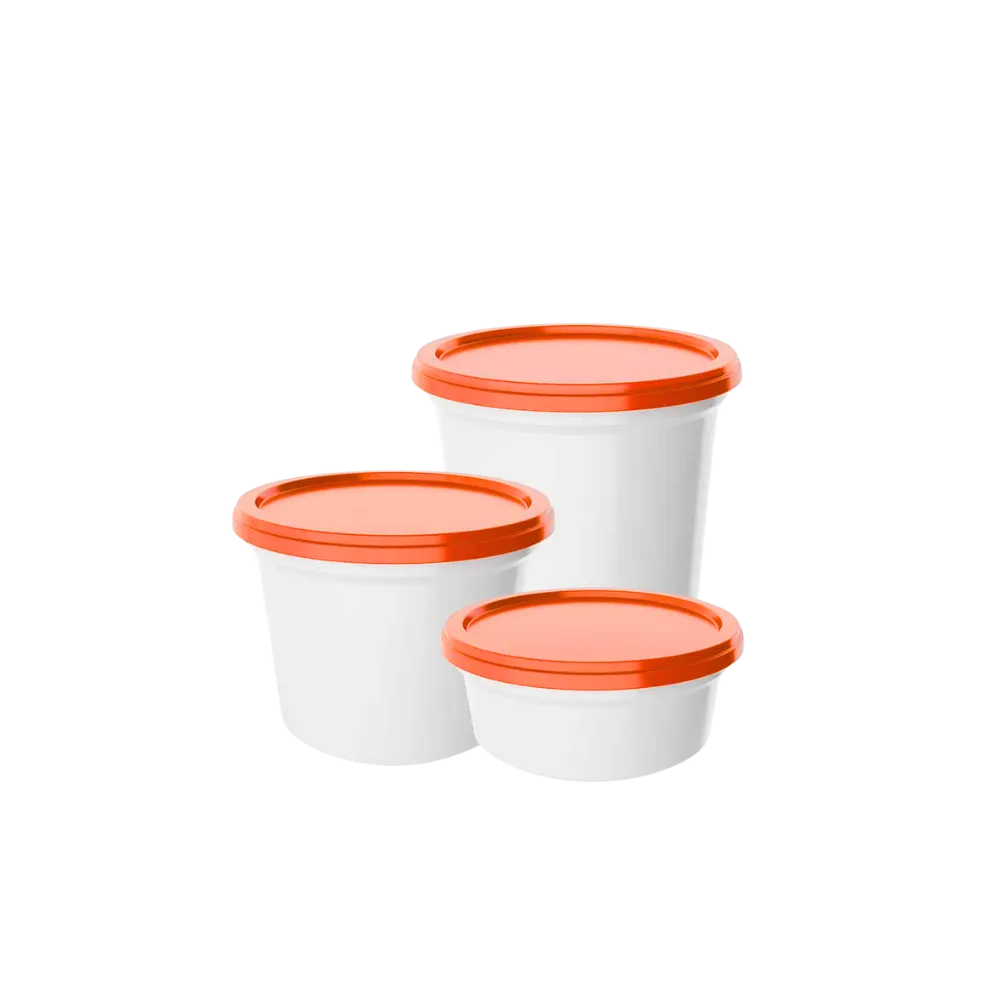
- The Plastiques Horizon Round Film Seal line comes in 8, 12, 16, 24 and 32 oz, all on a 409 diameter with one universal overcap.
What is a film seal container?
A film seal container is a rigid cup or tub that is closed on the filling line by heat-sealing a flexible lidding film to its rim. The film is the primary closure: it keeps the product in and outside contaminants out until the consumer peels it off. Most multi-serve film seal containers also get a rigid overcap, a snap-on lid that protects the film in transport and lets the consumer reclose the container after opening.
Film seal containers are also called heat-seal, sealable or fill-and-seal containers. In French they are called *contenants operculables*, and the film is an *opercule*. They are the standard format for yogurt, sour cream, cottage cheese, dips, hummus, sauces and many deli salads.
Because the film must be peeled or pierced to reach the product and cannot be put back, a film seal is also a tamper-evident feature. For the other ways to make opening visible, see what tamper-evident food containers are.
How does heat sealing work?
Lidding film is usually a multi-layer laminate. Depending on the product, it can combine a printable outer layer, a barrier layer (foil, metallized film or plastic film) and an inner sealant layer that softens and bonds to the container rim. An equipment maker’s heat seal overview for soft dairy describes lidding supplied either as pre-cut die-cut lids or as continuous rollstock that is sealed and then trimmed.
On the line, a heated sealing head presses the film onto the rim. Three variables decide the result: temperature, pressure and dwell time (how long the head stays down). Too little of any of them gives a weak or incomplete seal; too much can scorch the film or distort the rim. Faster lines leave less dwell time, which makes the other two settings more critical.
Seals are designed either to peel cleanly, which most consumers expect on dairy and dips, or to weld, which gives a stronger bond but tears rather than peels when opened. The choice is made with your film supplier and depends on the product, the shelf life and how the package is opened.
What makes a container rim good for sealing?
- A flat, wide sealing surface. The film needs a continuous, even land to bond to; a wider rim gives a larger seal area.
- Support under the rim. During sealing the head pushes down on the rim. The container must be supported by its flange or by a shoulder below the rim, matching how your sealer’s tooling holds it.
- Consistent dimensions. Rim diameter, flatness and height must stay within tolerance from cup to cup so the sealing head meets every rim the same way.
- Material compatibility. The film’s sealant layer must be formulated to bond to the container material; a film designed for polypropylene (PP) cups differs from one designed for PET.
- A standard diameter. Containers built on a common diameter, such as 409, share film size, sealing tooling and overcap across several heights. See what 409 means.
Film seal container or snap-on lid only?
| Criterion | Film seal + overcap | Snap-on lid only |
|---|---|---|
| Primary closure | Heat-sealed lidding film | Rigid lid pressed onto the rim |
| Equipment on the line | Film sealer (rotary or inline), film supply | Lid placement by hand or with a lidder |
| Evidence of first opening | Peeled or pierced film | Depends on the lid design (tamper-evident rim, tab or band) |
| Reclosable | Yes, with the overcap | Yes |
| Materials to buy | Container, film, overcap | Container, lid |
| Typical products | Yogurt, dips, sour cream, sauces | Deli salads, prepared foods, bulk products |
Film seal containers: advantages and limits
Pros
- The sealed film gives a clear, one-time evidence of opening.
- The film adds a sealed layer under the overcap, which suits liquid and spoonable products.
- Printed film adds a second branding surface.
- Containers on a common diameter share one film size and one overcap.
Cons
- Requires a heat sealer and film supply on the filling line.
- Seal quality depends on controlling temperature, pressure and dwell time.
- Three components (container, film, overcap) to source and qualify instead of two.
- Film is an extra material for the consumer to separate at disposal.
How is seal quality tested?
Two ASTM standards are widely used. ASTM F88/F88M measures the force needed to separate a strip cut through the seal, including seals between a flexible film and a rigid container. ASTM F2824 measures the force to peel the entire flexible lid from a rigid or semi-rigid round cup or bowl. Plants also run leak checks and visual inspection of the seal band.
Your film supplier usually recommends a starting sealing window. Confirm it on the actual container, at your line speed, before you approve a new cup or a new film.
Round Film Seal containers from Plastiques Horizon
The Plastiques Horizon Round Film Seal line is injection-molded in polypropylene (PP, resin code 5) in Saint-Lazare-de-Bellechasse, Québec. It comes in five formats: 8 oz (250 ml), 12 oz (375 ml), 16 oz (500 ml), 24 oz (750 ml) and 32 oz (1 L).
- Every size shares the same 409 diameter, so one universal overcap fits all five formats.
- The line is designed to run on existing 409 fill-and-seal lines, with a wide sealing rim and a choice of flange or shoulder support.
- Containers ship blank or decorated with full wrap-around, high-definition in-mold labels.
If you buy 409 film seal cups from a US supplier today, Plastiques Horizon can match your current cup and send samples to trial on your own sealer. See how we approach reshoring container supply, then request samples or a quote or call 1-877-630-4095.
Frequently asked questions
What is the difference between a film seal and an induction seal?
A film seal on a cup or tub is made by pressing a heated sealing head onto the lidding film and rim. An induction seal, common on bottles and jars, uses an electromagnetic field to heat a foil liner inside a cap so it bonds to the container lip. Both leave a seal that must be broken to reach the product.
Why do film seal containers also have a plastic lid?
The heat-sealed film is a one-time closure: once the consumer peels it, it cannot be put back. A snap-on overcap protects the film from punctures during shipping and display, and lets the consumer reclose a multi-serve container after the first opening. Single-serve cups often skip the overcap.
Can I use a different lidding film on my film seal containers?
Often yes, but validate it first. The new film’s sealant layer must be compatible with the container material, such as polypropylene, and the sealing window may change. Run trials on your line and check seal strength, peel behaviour and leaks before switching production.
Do film seal containers need a specific sealing machine?
They need a heat sealer whose tooling matches the container diameter, rim profile and support method. That is why many processors standardize on a common diameter such as 409: containers of several heights can then run on the same sealing tooling and film size.
Sources
External references consulted for this article. General information only, not legal or regulatory advice.
- ASTM F88/F88M-23: Standard Test Method for Seal Strength of Flexible Barrier Materials · ASTM International
- ASTM F2824-10(2020): Standard Test Method for Mechanical Seal Strength Testing for Round Cups and Bowl Containers with Flexible Peelable Lids · ASTM International
- Soft Dairy & Spoonable Foods Heat Seal Overview · Industrial Specialties Mfg. (heat seal tooling manufacturer)