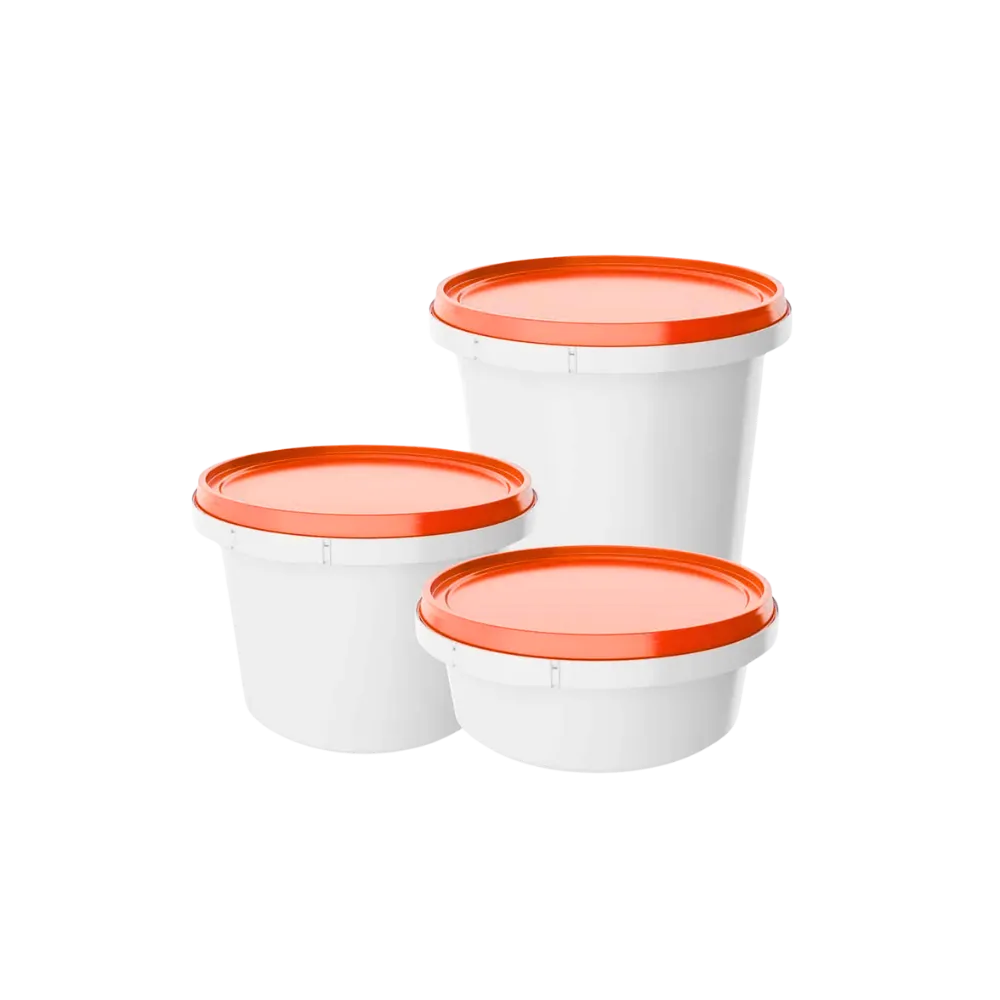
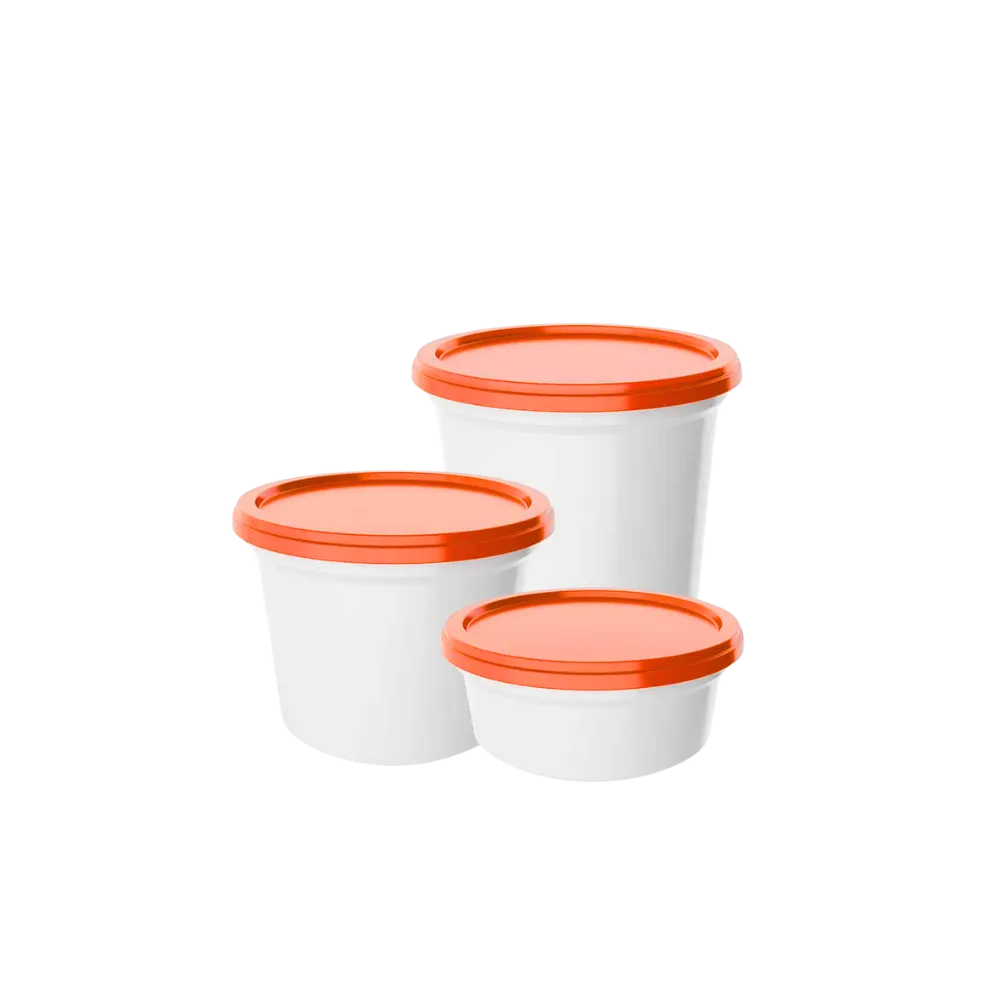
Short answer
Tamper-evident containers close with a lid and rim, or a band, that show visible evidence of first opening and need no sealing machine. Film seal containers are closed by a lidding film heat-sealed to the rim, which requires a sealer on the filling line. Tamper-evident lids suit simpler lines and hand packing; film seal suits liquid and spoonable products on fill-and-seal lines.
Key points
- Tamper-evident containers build the evidence of opening into the lid, rim or band; film seal containers rely on a heat-sealed lidding film.
- Film seal needs a heat sealer, film supply and seal validation; tamper-evident lids need only lid placement by hand or with a lidder.
- Both formats are reclosable for the consumer: the tamper-evident lid snaps back on, and a film seal container uses an overcap.
- Film seal on a common 409 diameter lets one overcap and one film size serve several cup heights.
- Plastiques Horizon makes both: Round Tamper-Evident (8 to 32 oz) and Round Film Seal (8 to 32 oz on a 409 diameter), blank or with IML.
What is the difference between tamper-evident and film seal containers?
Both formats answer the same question for the shopper: has this container been opened since it was filled? They answer it in different ways.
A tamper-evident container carries the evidence in its own rigid parts. Depending on the design, a rim, a tab, a strip or a band shows that the lid has been removed. The container is closed by pressing the lid on, by hand or with a lidding machine. For the full overview, see what tamper-evident food containers are.
A film seal container (also called a heat-seal container) is closed by a flexible lidding film that a sealing machine bonds to the rim with heat and pressure. The peeled or pierced film is the evidence of opening. A snap-on overcap is usually added on top so the consumer can reclose the container. For details, see what a film seal container is.
How do the two formats compare?
| Criterion | Tamper-evident container | Film seal container |
|---|---|---|
| Primary closure | Rigid lid on a tamper-evident rim, tab or band | Heat-sealed lidding film, plus an overcap |
| Evidence of first opening | Built into the rim, tab or band | Peeled or pierced film |
| Equipment on the line | Lid placement by hand or with a lidder | Heat sealer, film supply, sealing tooling |
| Process control | Lid fully seated | Temperature, pressure and dwell time within the sealing window |
| Components per package | Container and lid | Container, film and overcap |
| Reclosable after opening | Yes | Yes, with the overcap |
| Typical products | Deli salads, prepared foods, spreads, hand-packed products | Yogurt, sour cream, dips, hummus, sauces |
| Plastiques Horizon line | Round Tamper-Evident, Square Tamper-Evident, Tamper-Evident Buckets | Round Film Seal (409 diameter) |
Decoration also works a little differently. On an injection-molded tamper-evident container, an in-mold label (IML) can cover the wall and, on some lines, the lid, so the whole package is decorated by the molder. On a film seal container, the wall can carry an in-mold label while the lidding film is printed separately by the film supplier, which gives you a second surface for branding, a promotion or bilingual information.
What are the pros and cons of tamper-evident containers?
Tamper-evident containers
Pros
- No heat sealer or film needed, so they fit deli counters, commissary kitchens and simpler filling lines.
- Two components (container and lid) to buy, store and qualify.
- Evidence of opening is built into the package and does not depend on sealing settings.
- Quick changeover between products, since there is no sealing window to re-validate.
Cons
- No sealed film layer under the lid, which some liquid or spoonable products and some buyers require.
- The tamper-evident design is fixed by the mold; changing it means new tooling.
- Lids must be fully seated on the line, or the container may look opened on the shelf.
What are the pros and cons of film seal containers?
Film seal containers
Pros
- The heat-sealed film adds a sealed layer under the overcap, which suits liquids and spoonable foods.
- A peeled or pierced film is a clear, familiar sign of opening for consumers.
- Printed film adds a second branding and information surface.
- On a common 409 diameter, one overcap and one film size can serve several cup heights.
Cons
- Requires a heat sealer, sealing tooling matched to the rim and a film supply.
- Seal quality must be validated and monitored; seal strength is commonly tested to ASTM F88 or ASTM F2824.
- Three components to source and qualify instead of two.
- The film is an extra material the consumer must separate at disposal.
Which format suits your product?
- Yogurt, sour cream and cottage cheese on an automated line: film seal is the usual format, and a 409 diameter lets one overcap serve several sizes.
- Dips, hummus and sauces: both work. Film seal is common for retail lines with a sealer; tamper-evident tubs suit smaller producers packing without one.
- Deli salads and prepared foods packed at a counter or in a commissary kitchen: tamper-evident containers avoid the need for sealing equipment.
- Products the consumer reheats: check each line’s stated use. At Plastiques Horizon, the Round Tamper-Evident line is the one stated dishwasher, microwave and freezer safe.
- Bulk food service products in litre formats: pails with a tamper band, such as the Tamper-Evident Buckets from 2.6 L to 5.5 L.
Whichever closure you choose, test samples on your own line and through your own distribution before approving it. In Canada, section 7 of the Safe Food for Canadians Act prohibits tampering with food, its label or its package; packaging that makes opening visible supports that protection. This article is general information, not legal or regulatory advice.
Both formats from one Québec molder
Plastiques Horizon injection-molds both closure types in polypropylene (PP, resin code 5) in Saint-Lazare-de-Bellechasse, Québec, so you can compare them side by side from one supplier:
- Round Tamper-Evident: 8, 12, 16, 24 and 32 oz (250 ml to 1 L), one airtight, leakproof, IML-ready lid. The tamper-evident rim shows at a glance whether a container has been opened.
- Round Film Seal: 8, 12, 16, 24 and 32 oz (250 ml to 1 L), all on a 409 diameter with one universal overcap, a wide sealing rim and flange or shoulder support for existing 409 fill-and-seal lines.
Both lines are sold blank or decorated with full wrap-around in-mold labels. Ask for samples of each, run them on your line, and choose with real data. Request samples or a quote, or call 1-877-630-4095, Monday to Friday, 8:00 to 17:00 Eastern.
Frequently asked questions
Can a container be both film sealed and tamper-evident?
Yes. A heat-sealed lidding film is itself a tamper-evident feature, because it must be peeled or pierced to reach the product and cannot be put back. Some packagers add a second feature, such as a seal label or shrink band over the overcap, when a buyer asks for evidence that is visible without lifting the lid.
Is film seal more expensive than a tamper-evident lid?
The answer depends on your volumes, equipment and film. Film seal adds a sealer, sealing tooling and lidding film to the cost, while a tamper-evident container needs only the container and lid. If you already own a 409 sealer, the comparison changes. Ask suppliers to quote both on your actual volumes.
Can I switch from film seal to tamper-evident containers without changing my line?
Not directly. A film seal line is built around the sealer, while a tamper-evident container needs lid placement instead. Switching usually means bypassing or replacing the sealing station and adding a lidding step. Run a trial with samples to check line speed and lid seating before committing.
Which closure is better for shelf life?
Shelf life depends on the product, its processing, the barrier properties of the container and film, and storage temperature, not on the closure style alone. A sealed film can add a barrier layer chosen for the product. Confirm shelf life with your own testing on the final package.
Sources
External references consulted for this article. General information only, not legal or regulatory advice.
- ASTM F88/F88M-23: Standard Test Method for Seal Strength of Flexible Barrier Materials · ASTM International
- ASTM F2824-10(2020): Standard Test Method for Mechanical Seal Strength Testing for Round Cups and Bowl Containers with Flexible Peelable Lids · ASTM International
- Safe Food for Canadians Act (S.C. 2012, c. 24), section 7: Tampering · Justice Laws Website, Government of Canada
- Loi sur la salubrité des aliments au Canada (L.C. 2012, ch. 24), article 7 : Altération · Site Web de la législation (Justice), gouvernement du Canada