Short answer
Custom printed food containers are stock-shape containers decorated with a brand’s own artwork, most often by in-mold labeling (IML) on polypropylene. Private label packaging for grocers and food brands rarely needs a custom mold: Plastiques Horizon decorates every one of its six stock lines with IML in Québec, from 8 oz (250 ml) tubs to 5.5 L buckets, so the brand owns the look without owning tooling.
Key points
- Most private label food packaging uses a stock container shape with custom decoration, not a custom mold.
- In-mold labeling fuses a printed polypropylene label into the container wall, so the decoration does not peel and the package is recycled as one material.
- Every Plastiques Horizon format, across six lines, is available blank or decorated with IML: full wrap on round lines and buckets, 1 to 5 sides on the square line.
- In Canada, a prepackaged food label must show the name and principal place of business of the responsible party; wording such as "prepared for" is voluntary.
- Brands that already own a custom mold can ask Plastiques Horizon about a mold transfer instead.
What are custom printed food containers?
A custom printed food container is a container that carries your brand, product name and mandatory label copy directly on the package. There are two ways to get one. You can design a custom shape and pay for a dedicated injection mold, or you can choose a proven stock shape and customize only the decoration.
For most grocers, private label programs and growing food brands, the second route is the practical one. A stock format is already molded in volume, already fits standard filling and sealing equipment, and can be sampled right away. The brand identity lives in the artwork, which is what the shopper actually sees.
On polypropylene (PP) containers, the leading decoration method is in-mold labeling (IML). A printed polypropylene label is placed inside the mold before the plastic is injected, and it fuses with the container wall. Our in-mold labeling page shows how we run the process.
How does private label packaging work for grocers and brands?
In a typical private label program, a retailer or brand owner sells food made by a co-packer or processor under the retailer’s own brand. The packaging is often bought by the processor but designed for the brand owner. Both parties need the same thing from the container: a consistent look across products and suppliers, compliant label copy, and a format the filling line can run.
Stock formats with custom IML make that easier. A private label hummus, a house-brand yogurt and a store-made soup can share a family look across round and square containers of different sizes, while each processor fills a container its line already handles. When volumes or recipes change, the artwork changes, not the tooling.
Custom mold or stock format with IML?
Both routes produce a branded container. The table compares them on the points buyers ask about most.
| Factor | Custom mold | Stock format + custom IML |
|---|---|---|
| Container shape | Unique to your brand | Shared stock shape |
| Upfront tooling | Mold design and build paid by the brand | No container mold to buy |
| Time to first delivery | Includes mold design, build and trials | Starts from existing formats; schedule confirmed with your quote |
| Line compatibility | Must be validated from scratch | Stock formats already designed for common lines (for example 409 fill-and-seal) |
| Changing the design | Shape changes need mold work | Change the label artwork |
| Ownership questions | Mold ownership must be documented | Brand owns its artwork |
Custom mold
Pros
- A container shape no competitor can use
- Every dimension set for your product and line
Cons
- Tooling investment and engineering time before the first part
- Shape changes later require mold modifications
- Mold ownership, storage and transfer need written agreements
Stock format with custom IML
Pros
- No container mold to buy
- Samples of the exact format available before you commit
- Artwork can change between runs or between products
- Photo-quality IML fused into the wall, so the decoration does not peel
Cons
- The shape is not exclusive to your brand
- You choose from the sizes and closures the catalogue offers
Which Plastiques Horizon formats can be custom printed?
Every format in our catalogue can be sold blank or decorated with IML. The decorated surface depends on the shape of the line.
| Line | Sizes | IML decoration |
|---|---|---|
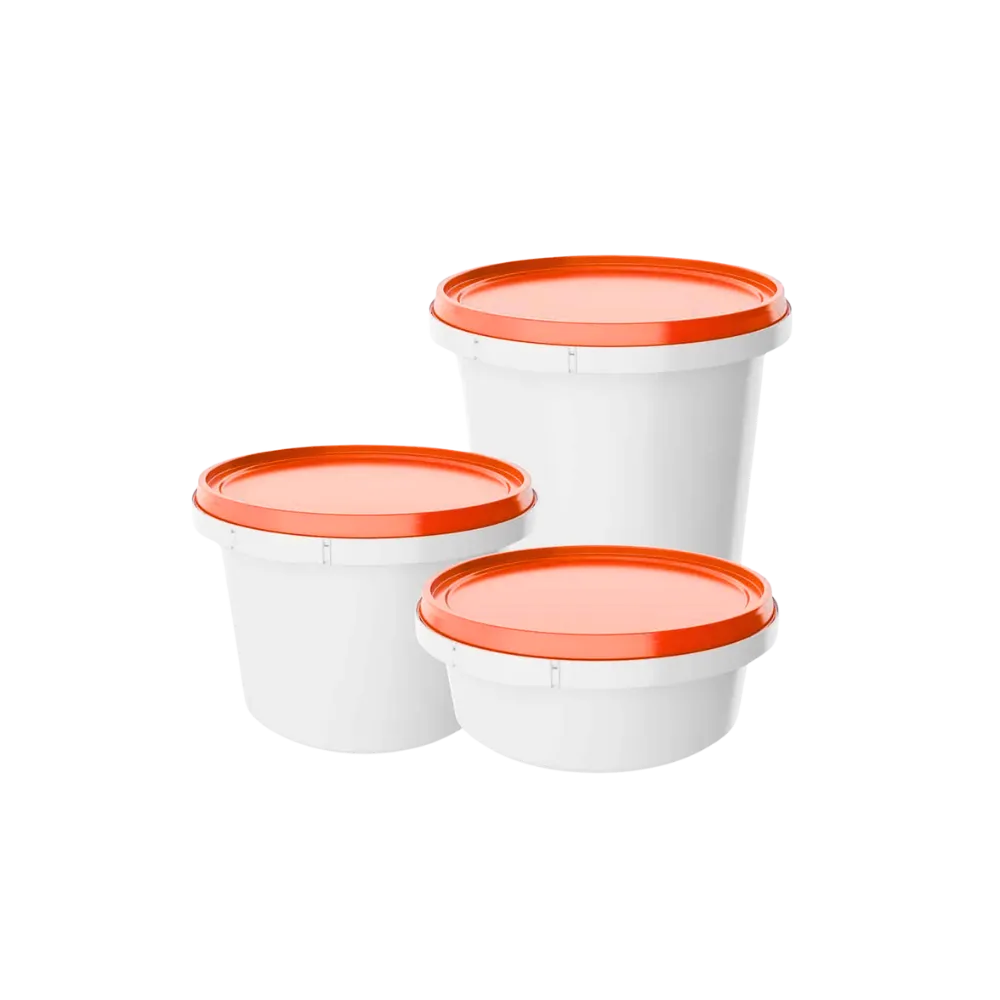
| Round Tamper-Evident | 8 to 32 oz (250 ml to 1 L), 5 formats | Full wrap-around on the body, IML on the lid |
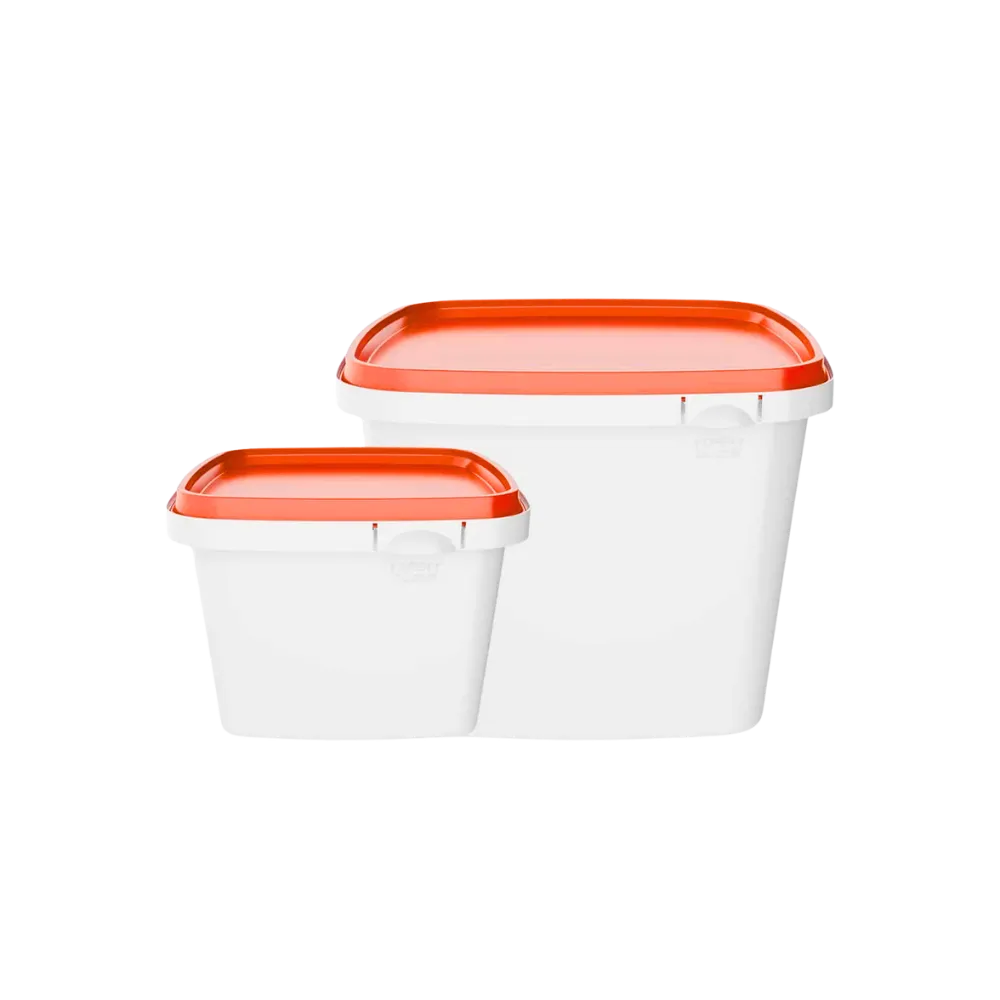
| Square Tamper-Evident | 8 to 48 oz (250 ml to 1.5 L), 6 formats | IML on 1 to 5 sides, IML-enabled lids |
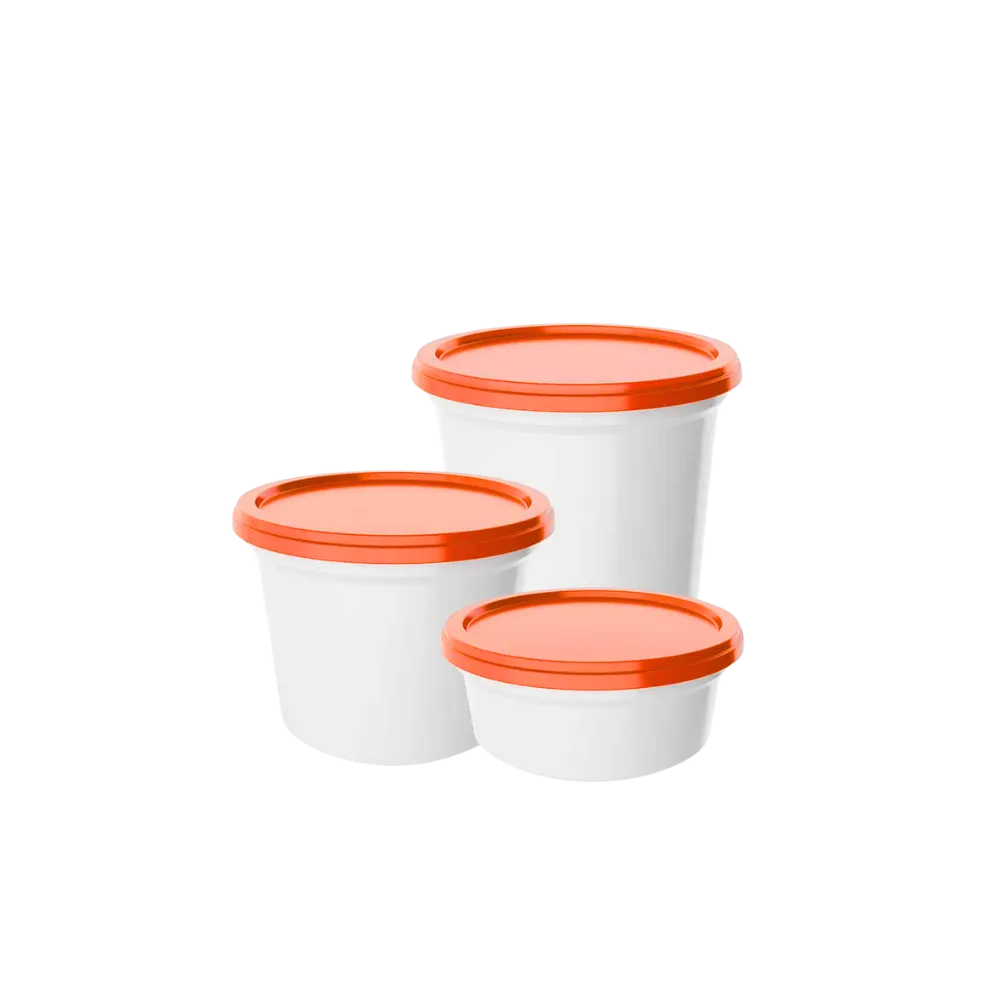
| Round Film Seal | 8 to 32 oz (250 ml to 1 L), 5 formats, 409 diameter | Full wrap-around HD IML |
| Tamper-Evident Buckets | 2.6 L to 5.5 L, 6 formats | Full wrap-around IML |
| Rectangle | 16 to 38 oz (500 ml to 1.12 L), 5 formats | IML available |
| Heavy-Duty Deli | 8 to 32 oz (250 ml to 1 L), 6 formats | Full wrap-around IML |
Plastiques Horizon places labels with Wittmann IML robotics on Sumitomo injection molding presses, so containers come out of the press already decorated. Label and container are both polypropylene, resin identification code 5. If you are weighing whether decoration is worth it for a given product, weigh the trade-offs between blank and IML-decorated containers for that product first.
What must a private label food container say?
The decorated surface has to carry the mandatory label information, so plan the artwork around it. Three Canadian Food Inspection Agency (CFIA) rules come up in nearly every private label project:
- Name and principal place of business: the CFIA states that prepackaged foods requiring a label must declare the name and principal place of business of the responsible party, which may be the party the food was made for. Terms such as "prepared for" or "distributed by" may be added voluntarily (CFIA guidance).
- Two languages: mandatory information on consumer prepackaged food must be shown in both English and French, and Québec has additional French-language requirements (CFIA bilingual labelling).
- Net quantity: on consumer prepackaged foods, the net quantity must be declared on the principal display panel in metric units (CFIA net quantity).
A full wrap-around in-mold label, or labels on up to five sides of a square container, gives room for both languages without crowding the brand. This article is general information, not legal advice; have your label reviewed against current CFIA requirements before printing.
How do you launch custom printed containers with Plastiques Horizon?
- Choose the line and sizes from the product catalogue and ask for samples to test on your line.
- Get the dielines. We provide the label dielines for the chosen formats and confirm the decoration surfaces available on each.
- Prepare the artwork. Your designer fits the artwork, including bilingual copy, to the dielines. Our IML artwork and dieline guide explains what to watch for.
- Labels are printed and die-cut to the dieline for each format before molding starts.
- Molding and delivery. Labels are placed in the mold by IML robotics, and decorated containers ship to your plant ready to fill.
For cost drivers and planning, read how to start an IML packaging program. Pricing, minimum quantities and lead times depend on the formats, the number of designs and the volumes, and are confirmed with your quote.
Private label containers made in Québec
Plastiques Horizon molds and decorates its containers at 311 Rte 279 in Saint-Lazare-de-Bellechasse, Québec, ships across Canada and works with brands and processors in English and French. Send us your products, formats and annual volumes, or call 1-877-630-4095, Monday to Friday, 8:00 to 17:00 Eastern.
Frequently asked questions
Do I need my own mold for custom printed food containers?
Usually not. Most custom printed food containers use a stock container shape with custom decoration. Plastiques Horizon decorates every format in its six stock lines with in-mold labels, so a brand can launch a custom look without paying for a container mold. A custom mold only makes sense when the shape itself must be exclusive.
Can different products share one private label design system?
Yes. With in-mold labeling on stock formats, a retailer can apply one brand system across round, square and rectangular containers and buckets of different sizes. Each format has its own dieline, so the artwork is adapted per format while keeping the same colours, typography and layout logic.
Whose name goes on a private label food container in Canada?
The CFIA requires the name and principal place of business of the responsible party on prepackaged food, and that party may be the company the food was made for. Wording such as "prepared for" or "distributed by" is voluntary. Confirm your specific label with the CFIA guidance or a labelling specialist; this is not legal advice.
Can I start with blank containers and stickers before moving to IML?
Yes. Every Plastiques Horizon format is sold blank as well as decorated. Many brands launch with blank containers and pressure-sensitive labels to test products and artwork, then move steady sellers to in-mold labeling once designs and volumes are stable.
Sources
External references consulted for this article. General information only, not legal or regulatory advice.
- Name and principal place of business on food labels · Canadian Food Inspection Agency
- Nom et principal lieu d’affaires sur les étiquettes des aliments · Agence canadienne d’inspection des aliments
- Bilingual food labelling · Canadian Food Inspection Agency
- Net quantity on food labels · Canadian Food Inspection Agency