Short answer
An IML label dieline is the template that shows the exact shape of the in-mold label for one container format, with its cut line, bleed and safe area. Designers build artwork on the dieline supplied by the container molder, allow for the curved label shape of tapered round containers, include all mandatory bilingual food label text, and approve a proof before labels are printed.
Key points
- Always build in-mold label artwork on the dieline for the exact container format; each format has its own label shape.
- On tapered round containers the flat label is an arc, so horizontal elements must follow the curve to look straight on the container.
- Keep text, barcodes and logos inside the safe area and away from the label join, rim and base, as marked on the dieline.
- Mandatory information on consumer prepackaged food in Canada must appear in English and French, and Québec requires French on product inscriptions.
- Plastiques Horizon provides the dielines for its formats, including the 1 to 5 sides of the Square Tamper-Evident line and IML-ready lids.
What is an IML dieline?
In in-mold labeling (IML), a printed polypropylene label is placed in the injection mold and bonded into the container wall as the container is molded. The label must match the decorated surface of the mold exactly, so every container format has its own label shape. That shape is drawn on the dieline, the technical template your designer works on. If you are new to the process, start with What is in-mold labeling (IML)?.
A dieline typically shows these elements. Use the values marked on the dieline for your format rather than generic print rules, because IML tolerances are set by the mold and the label cutting.
- Cut line: the outline where the label is die-cut. Nothing printed outside it will appear on the container.
- Bleed: background colour and images extend beyond the cut line so no unprinted edge shows after cutting.
- Safe area: the inner zone for text, logos, barcodes and anything that must not be trimmed or hidden.
- Zones to keep clear: areas near the label join, the rim or the base where critical content should not go.
- Panel or face markings: on square containers, the individual faces; on lids, the lid label area.
How do you design for a tapered round container?
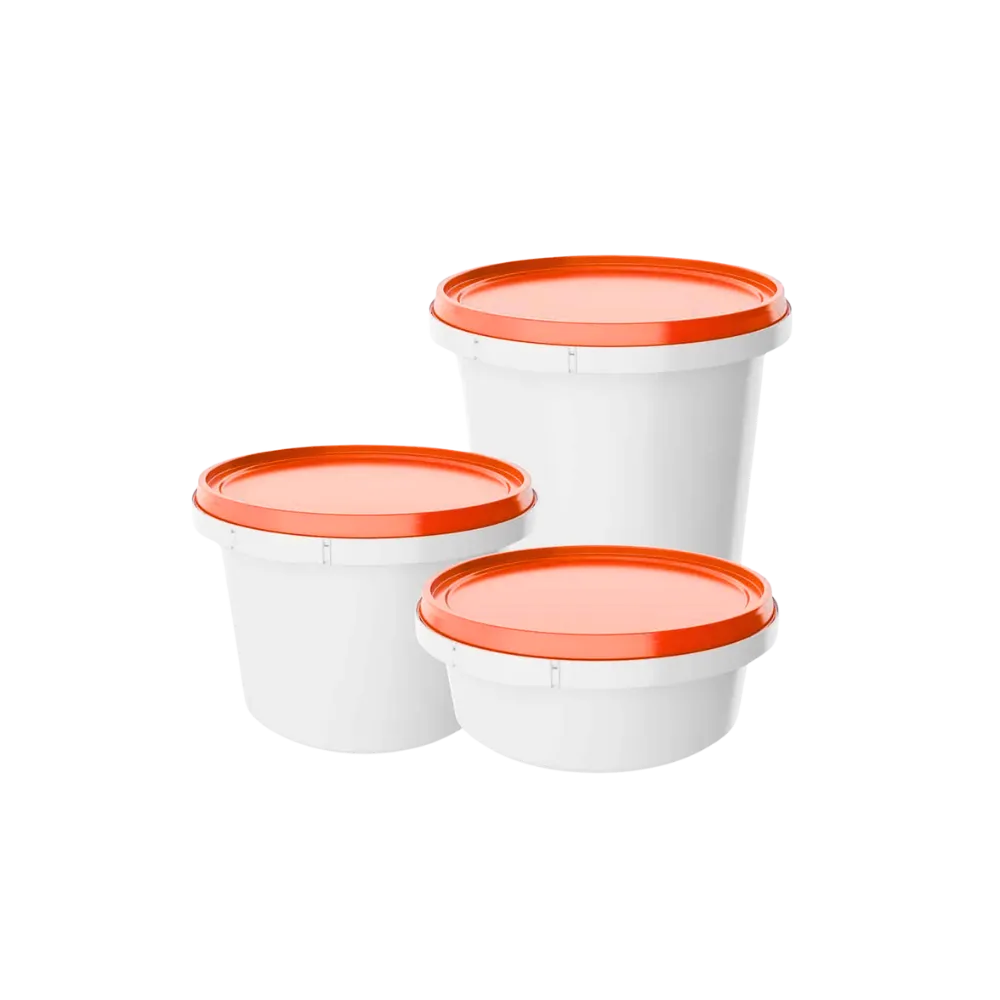
Most stackable tubs are tapered: wider at the top than at the base, so they nest. The side wall of a tapered container is part of a cone, and a cone unrolled flat is an arc, not a rectangle. That is why the full wrap-around label for a round tapered container, such as the Round Tamper-Evident line, is a curved band on the dieline.
This creates a predictable distortion. A line that is horizontal on the container is an arc on the flat label, and a line that is vertical on the container points toward the centre of that arc. Keep these rules in mind:
- Set text baselines, rules and borders along the arc of the dieline, not as straight horizontal lines.
- Keep logos, photos and nutrition tables upright along the radius of the arc; small elements are barely affected, large ones should be checked on a mock-up.
- Do not stretch rectangular artwork to fill the arc; rebuild it on the dieline.
- Plan for the join where the two ends of a wrap-around label meet, and keep text and barcodes away from it.
- Check scannability of barcodes on a decorated sample, because the container curve affects how a scanner reads them.
How do you design for a square container?
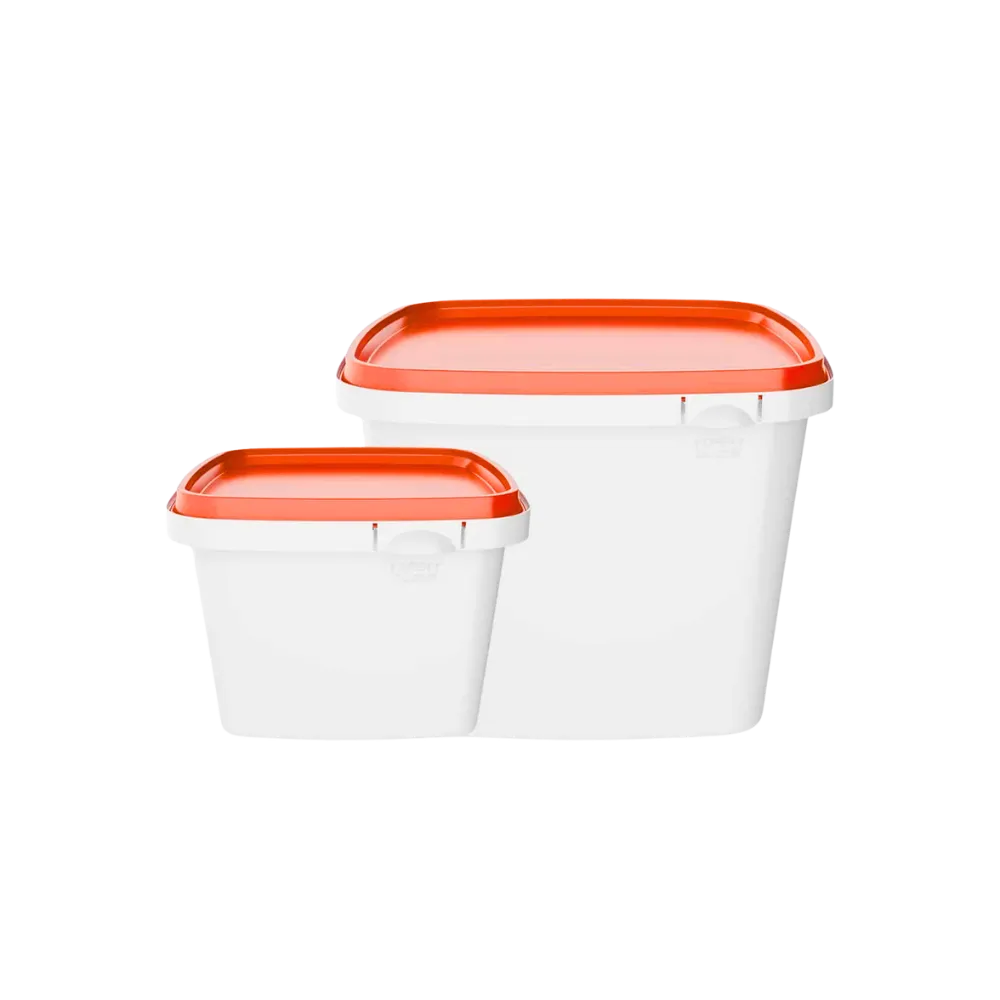
The Square Tamper-Evident line takes in-mold labels on 1 to 5 sides, which lets you treat each face as a panel: a front display panel, a back panel for ingredients and nutrition, side panels for the bilingual common name or serving ideas. We confirm the decoration surfaces available on each format when you choose the sizes.
The line uses two lid sizes: a 4-inch lid for the 8, 12 and 16 oz (250, 375 and 500 ml) formats and a 5.5-inch lid for the 32, 40 and 48 oz (1 L, 1.2 L and 1.5 L) formats. Both lids are IML-enabled. A lid label is useful because the top is what shoppers see in a cooler or a stacked display, and one lid design can serve all three container sizes that share it.
What must the label say in English and French?
According to the Canadian Food Inspection Agency guidance on bilingual food labelling, mandatory information on consumer prepackaged food must be shown in both English and French (section 206 of the Safe Food for Canadians Regulations and B.01.012(2) of the Food and Drug Regulations). The name and principal place of business may be in either language. Our guide to bilingual packaging requirements covers exemptions and details.
In Québec, the Office québécois de la langue française states that any information on a product, its packaging or an accompanying document must be in French. Another language may be added but may not prevail over the French. Since June 1, 2025, the generic or descriptive elements of a trademark on a product must also appear in French.
Size and placement also matter. The CFIA page on legibility and location sets a general minimum character height of 1.6 mm for mandatory information, measured on the lowercase "o" when text is in mixed case, and requires the common name and net quantity on the principal display panel. Mandatory information may not appear solely on the bottom of the container. The net quantity numerals have their own minimum height based on the area of the principal display surface:
| Principal display surface area | Minimum character height |
|---|---|
| 32 cm² (5 in²) or less | 1.6 mm (1/16 in) |
| Over 32 cm² up to 258 cm² (40 in²) | 3.2 mm (1/8 in) |
| Over 258 cm² up to 645 cm² (100 in²) | 6.4 mm (1/4 in) |
| Over 645 cm² up to 2 580 cm² (400 in²) | 9.5 mm (3/8 in) |
| Over 2 580 cm² (400 in²) | 12.7 mm (1/2 in) |
This section is general information, not legal advice. Confirm your label content with a regulatory specialist before approving artwork.
Artwork file and approval checklist
- Confirm the line, formats and decorated surfaces, and request the dieline for each format.
- Build artwork on the dieline at full size, in a layered vector file, with the dieline on its own non-printing layer.
- Extend backgrounds into the bleed and keep all text, logos and barcodes inside the safe area.
- Embed or outline fonts, link high-resolution images, and identify any spot colours by reference.
- Write the bilingual copy first, then lay it out: French text usually runs longer than English and needs room.
- Check minimum type sizes and that the common name and net quantity sit on the principal display panel.
- Review a proof against the dieline, then approve it in writing before labels are printed.
- Check a decorated sample: colours, barcode scanning and alignment on the actual container.
Dielines and IML support from Plastiques Horizon
Plastiques Horizon provides the label dielines for the formats you choose, and your designer prepares the artwork to fit them, including bilingual copy. Labels are printed and die-cut to the dieline for each format, then placed in the mold by Wittmann IML robotics on our Sumitomo presses in Saint-Lazare-de-Bellechasse, Québec. Every format can also be bought blank if you need containers before your IML program is ready.
Quotes and support are available in English and French. To get dielines, see the in-mold labeling page, browse the product lines, or request a quote with your formats and annual volumes. You can also call 1-877-630-4095 and ask for samples to mock up your artwork on the real container.
Frequently asked questions
Can I use the same IML artwork on different container sizes?
Not directly. Each container format has its own label shape and size, so the artwork must be adapted to each dieline. You can keep the same design system, colours and copy across a range, but expect to rebuild the layout for each format and to approve a separate proof for each label.
Should the French or the English text come first on a bilingual label?
Federal rules require mandatory information in both languages but do not dictate which language comes first. For products sold in Québec, the OQLF states that text in another language must not prevail over the French. Many brands lead with French or give both languages equal treatment. Confirm your layout with a regulatory specialist.
What file format should I send for IML artwork?
Send a layered, editable vector file built on the dieline at full size, with fonts embedded or supplied, images linked at high resolution and spot colours identified. Keep the dieline on its own layer. Ask the molder which file types and colour settings the label printer accepts before artwork starts.
Where should the best-before date go on an IML container?
Plan a clear area for it. Dates and lot codes change every production run, so they are normally printed at filling, often on the lid or a plain zone of the container. Leave that zone free of artwork and confirm with your coding equipment supplier that the ink adheres to the label surface.
Sources
External references consulted for this article. General information only, not legal or regulatory advice.
- Bilingual food labelling · Canadian Food Inspection Agency
- Legibility and location of food labelling information · Canadian Food Inspection Agency
- Entreprises : marque de commerce sur les produits · Office québécois de la langue française