Short answer
PP vs HDPE pails: polypropylene (PP, code 5) pails are stiffer, tolerate higher temperatures for hot fill and take crisp in-mold labels, which suits branded food pails. HDPE (high-density polyethylene, code 2) pails are tougher in the cold and more flexible, which suits frozen products and rough industrial handling. Both are food-contact plastics regulated under 21 CFR 177.1520.
Key points
- Polypropylene (code 5) and HDPE (code 2) are both polyolefins listed for food contact under 21 CFR 177.1520.
- Polypropylene pails are stiffer and handle hotter fills; HDPE pails are more flexible and keep their impact strength better in the cold.
- Polypropylene accepts in-mold labels made of the same material, so a decorated PP pail stays mono-material.
- Freezer use and drop performance depend on the resin grade and the pail design, so test with your product before you switch.
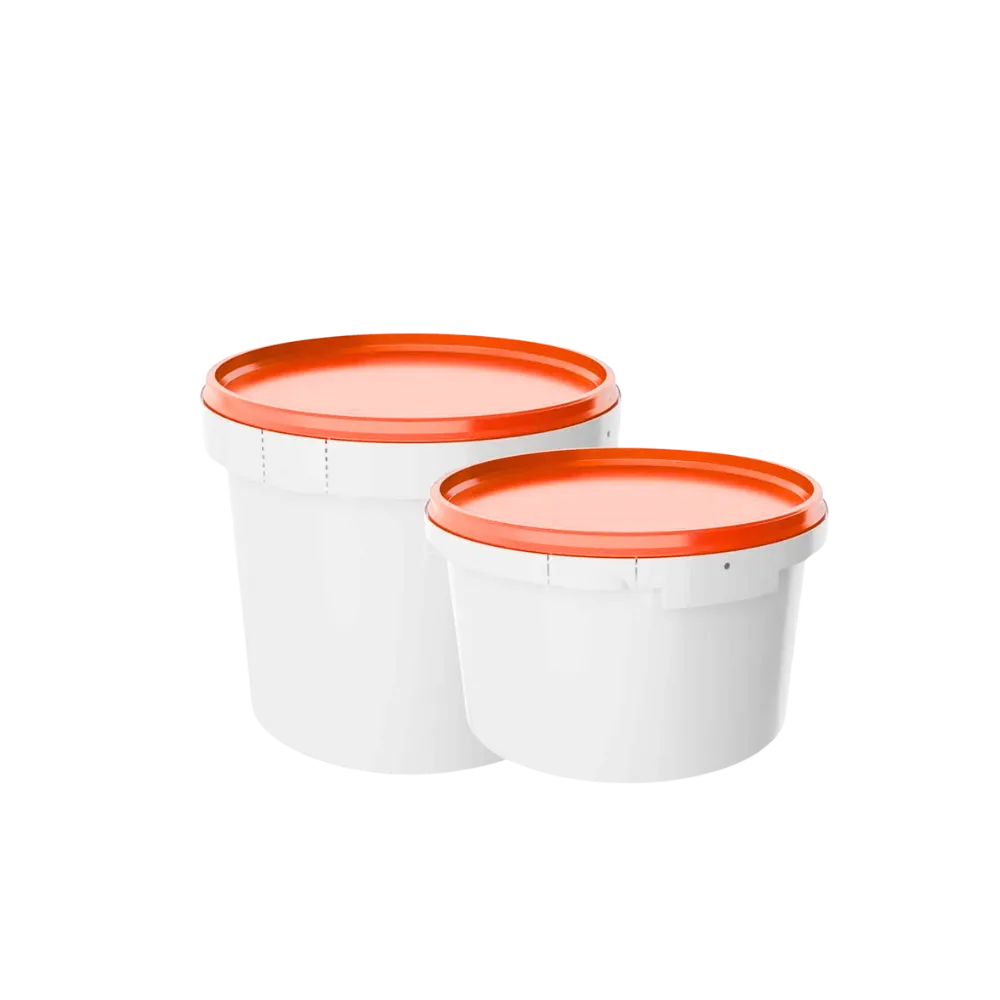
- Plastiques Horizon makes polypropylene tamper-evident buckets in six formats from 2.6 L to 5.5 L, blank or with full-wrap IML.
What are PP and HDPE?
Polypropylene (PP) and high-density polyethylene (HDPE) are both polyolefins, the family of plastics made from simple olefin building blocks (propylene and ethylene). PP is marked with resin identification code 5 and HDPE with code 2. Both are common in food packaging, and both are used for pails (called "chaudières" in Québec).
The American Chemistry Council describes PP as strong, with good chemical resistance and a high melting point that makes it good for hot-fill liquids. It describes HDPE as having good chemical resistance, which is why it is used for milk jugs and for household and industrial chemicals (ACC resin guide).
In the United States, both are covered by the same regulation, 21 CFR 177.1520, olefin polymers: polypropylene under item 1.1 and polyethylene under items 2.1 and following (21 CFR 177.1520). A food-grade claim applies to the specific resin grade, not to the family as a whole. Ask your pail supplier which grade it molds and for a written compliance statement covering the pail, the lid and any label.
How do PP and HDPE pails compare?
| Criterion | Polypropylene (PP) pail | HDPE pail |
|---|---|---|
| Resin identification code | 5 | 2 |
| Stiffness | Stiffer; holds shape with thinner walls | More flexible |
| Heat | Higher melting point; suited to hot-fill products | Lower melting point than PP |
| Cold and impact | Standard grades less impact resistant in the cold; copolymer grades improve this | Stays tough at low temperatures |
| Decoration | Widely decorated with in-mold labels | Decorated by IML or after molding, depending on the supplier |
| Chemical resistance | Good | Good |
| US food-contact regulation | 21 CFR 177.1520 (item 1.1) | 21 CFR 177.1520 (items 2.x) |
| Typical food uses | Sauces, spreads, condiments, food service bulk | Bulk ingredients, frozen products, industrial food service |
| Recycling (Québec) | Accepted as a non-deposit container | Accepted as a non-deposit container |
What are the pros and cons of polypropylene pails?
Polypropylene (PP, code 5) pails
Pros
- Higher heat tolerance for hot-filled sauces and soups.
- Stiffer walls keep their shape when stacked and when the lid is pressed on.
- Takes photo-quality in-mold labels, with a PP label that keeps the pail mono-material.
- Precise injection-molded rims for tamper bands and airtight lids.
Cons
- Standard grades are less impact resistant at freezer temperatures than HDPE.
- Can be less forgiving than HDPE when dropped, depending on grade and design.
- Freezer suitability must be confirmed per product.
What are the pros and cons of HDPE pails?
HDPE (code 2) pails
Pros
- Keeps its toughness at low temperatures, a strength for frozen products.
- Flexible walls that absorb impacts in rough handling.
- Good chemical resistance, widely used for industrial and bulk products.
Cons
- Lower heat tolerance than PP, which limits hot-fill use.
- More flexible walls may need more material for the same stiffness.
- Softer walls can flex under stacked loads, so stacking strength should be tested.
Which should you choose for food pails?
- Hot-filled sauces, soups and spreads: polypropylene.
- Branded pails on a retail or food service shelf: polypropylene with in-mold labeling, so the graphics are part of the wall.
- Frozen products with rough handling: HDPE, or ask your supplier about an impact-modified PP grade and test it.
- Tamper evidence for bulk food: either resin can carry a tamper band; check how the band behaves with your capping method. See what tamper-evident containers are.
Pails and their lids are tightly matched parts. If you switch resin or supplier, test on your own line before you commit.
What should you test when you change pail material?
- Drop test with filled pails at the real storage temperature (chilled, ambient or frozen).
- Stack test with full pallets for the time and temperature of your warehouse and transport.
- Lid fit and seal on your capping equipment, including the tamper band.
- Fill temperature, if you hot-fill, with the lid applied at production speed.
- Decoration: label quality, scuff resistance in handling, and legibility of bilingual copy.
Are PP and HDPE pails recyclable?
Both resins are recyclable thermoplastics. In Québec, the modernized curbside collection in force since January 2025 accepts all non-deposit containers and packaging whatever the number on the symbol (Québec.ca). In British Columbia, Recycle BC accepts plastic pails up to 25 L, excluding pails used for lubricants and oils (Recycle BC). See is #5 plastic recyclable in Canada.
Polypropylene buckets from Plastiques Horizon
Plastiques Horizon molds Tamper-Evident Buckets in polypropylene at its plant in Saint-Lazare-de-Bellechasse, Québec. Each bucket has a secure tamper band, an airtight leakproof lid and a carry handle, and is sold blank or decorated with full-wrap in-mold labels. US gallon figures below are approximate (1 US gallon = 3.785 L).
| Capacity | US fl oz | Approx. US gal | Item | Lid |
|---|---|---|---|---|
| 2.6 L | 85 oz | 0.69 gal | 85226 | 85251 |
| 3.2 L | 108 oz | 0.85 gal | 85232 | 85251 |
| 3.8 L | 128 oz | 1.0 gal | 85238 | 85251 |
| 4.5 L | 152 oz | 1.19 gal | 85245 | 85252 |
| 5.0 L | 169 oz | 1.32 gal | 85250 | 85252 |
| 5.5 L | 186 oz | 1.45 gal | 85255 | 85252 |
The buckets suit sauces, spreads, condiments and food service bulk. If you buy pails from a US molder today, Plastiques Horizon can match a format or plan a mold transfer. Read the full tamper-evident buckets guide, request samples through our contact page, or call 1-877-630-4095.
Frequently asked questions
Is a food grade bucket PP or HDPE?
Food grade buckets are made in both. "Food grade" refers to a resin grade and formulation that meets food-contact rules, such as 21 CFR 177.1520 in the United States, not to one specific plastic. Check the resin code on the bottom of the pail (5 for PP, 2 for HDPE) and ask the supplier for a compliance statement.
Can a polypropylene pail go in the freezer?
Many can, but it depends on the resin grade and the pail design. Standard polypropylene becomes less impact resistant as it gets colder, while copolymer grades hold up better. If your product is frozen, ask the supplier whether the pail is stated freezer safe and run a drop test with filled pails at freezer temperature.
How many litres is a 1 gallon pail?
One US gallon is about 3.785 litres, so a "1 gallon" food pail is roughly 3.8 L. Pail capacities are nominal, and fill volume is lower than brimful capacity, so confirm the usable volume with your product. A 3.8 L polypropylene bucket corresponds to about 128 US fl oz.
Can HDPE pails be decorated with in-mold labels?
In-mold labeling is used on several plastics, and the label film is normally chosen to match the container resin so the package stays recyclable as one material. Polypropylene pails with polypropylene labels are a common combination for branded food pails. Ask your supplier which resins and label films it runs on its IML equipment.
Sources
External references consulted for this article. General information only, not legal or regulatory advice.
- 21 CFR § 177.1520 Olefin polymers · Legal Information Institute, Cornell Law School
- Plastic Packaging Resins (resin identification code guide) · American Chemistry Council (copy hosted by Carroll County Government, Maryland)
- Gestion des matières résiduelles : entrée en vigueur du système modernisé de collecte sélective · Gouvernement du Québec
- Containers: What Can I Recycle? · Recycle BC