Short answer
To choose a food container size, start from the net quantity you will declare on the label, convert it to the volume your product actually occupies, then add headspace for sealing and handling. Pick the nominal size whose brimful capacity covers that volume, and confirm the choice with a test fill of real samples on your own line before you print labels.
Key points
- Choose a container size from your declared net quantity and real product volume, not from the nominal size printed in a catalogue.
- Brimful capacity, fill volume and headspace are three different numbers; you need all three to pick a format.
- The CFIA says it is not acceptable to under-fill a container in a way that misleads about quantity, so avoid oversized formats.
- A test fill on your own line, with sealing, shipping and storage checks, is the only reliable way to confirm a size.
- Lid commonality, shelf footprint and decoration surface matter as much as volume when you choose a format.
Why start from the net quantity, not the container size?
The number your customer sees is the net quantity on the label, and it is the number you are legally bound to deliver. According to the CFIA, the net quantity on consumer prepackaged food must be declared in metric units on the principal display panel: generally by volume in millilitres for liquids and by weight in grams for solids.
Container sizes, by contrast, are nominal. A "16 oz (500 ml)" container is a size class; its exact capacity depends on the design. So work from your product toward the container, not the other way around.
- Decide the net quantity you want to sell (for example 500 g of hummus or 750 ml of soup).
- If you declare by weight, estimate the volume your product occupies at filling temperature. Density varies by recipe, so weigh and measure a real batch.
- Add the headspace your process needs (see below).
- Choose the smallest format whose brimful capacity comfortably covers that total.
- Confirm with a test fill before you approve artwork.
What is the difference between brimful capacity, fill volume and headspace?
| Term | Definition | Why it matters |
|---|---|---|
| Nominal size | The size class used to name the container, such as 16 oz (500 ml) | Useful for comparing catalogues, not for setting your fill |
| Brimful capacity | The volume the container holds when filled level to the top edge | The upper limit; ask your supplier for it per format |
| Fill volume | The volume of product you actually put in | Must deliver the declared net quantity on every container |
| Headspace | The empty space left between the product and the closure | Protects the seal, absorbs movement and expansion, prevents spills |
How much headspace does a food container need?
There is no single number; the right headspace depends on your product and your process. Ask these questions:
- Is the container film sealed? A heat-seal film needs a clean, dry sealing rim. Leave enough space that product does not splash onto the flange during filling and conveying. See what a film seal container is.
- Is the product filled hot or frozen afterwards? Many foods change volume with temperature, and frozen products with high water content expand. Test at your real filling and storage temperatures.
- Does the product move in transit? Liquids and loose items need room so the lid is not forced when cases are stacked or handled.
- Will the consumer reheat or reseal it? A product that is stirred, microwaved or resealed by the consumer usually needs more space than one eaten straight from the container.
Too much headspace is also a problem. The CFIA states that it is not acceptable to under-fill a container with a product, as this would be misleading with respect to the quantity. If your product genuinely needs extra space, the label should explain why.
How do you run a test fill?
- Request samples of two or three candidate sizes, plus their lids.
- Weigh empty containers, then fill with your real product at production temperature to your target net quantity.
- Close or seal on your own equipment, at line speed if possible.
- Check the fill line, the seal or lid fit, and whether product touches the rim or lid.
- Run storage tests that match your product: refrigerated, frozen, stacked in cases, shipped.
- Record brimful capacity, fill weight and headspace for the format you choose, and use those numbers in your specification.
What else should influence the size you choose?
Volume is only one factor. These others often decide between two sizes that both fit:
- Lid commonality. A range of sizes that shares one lid means fewer items to stock and less changeover on your capping or sealing equipment.
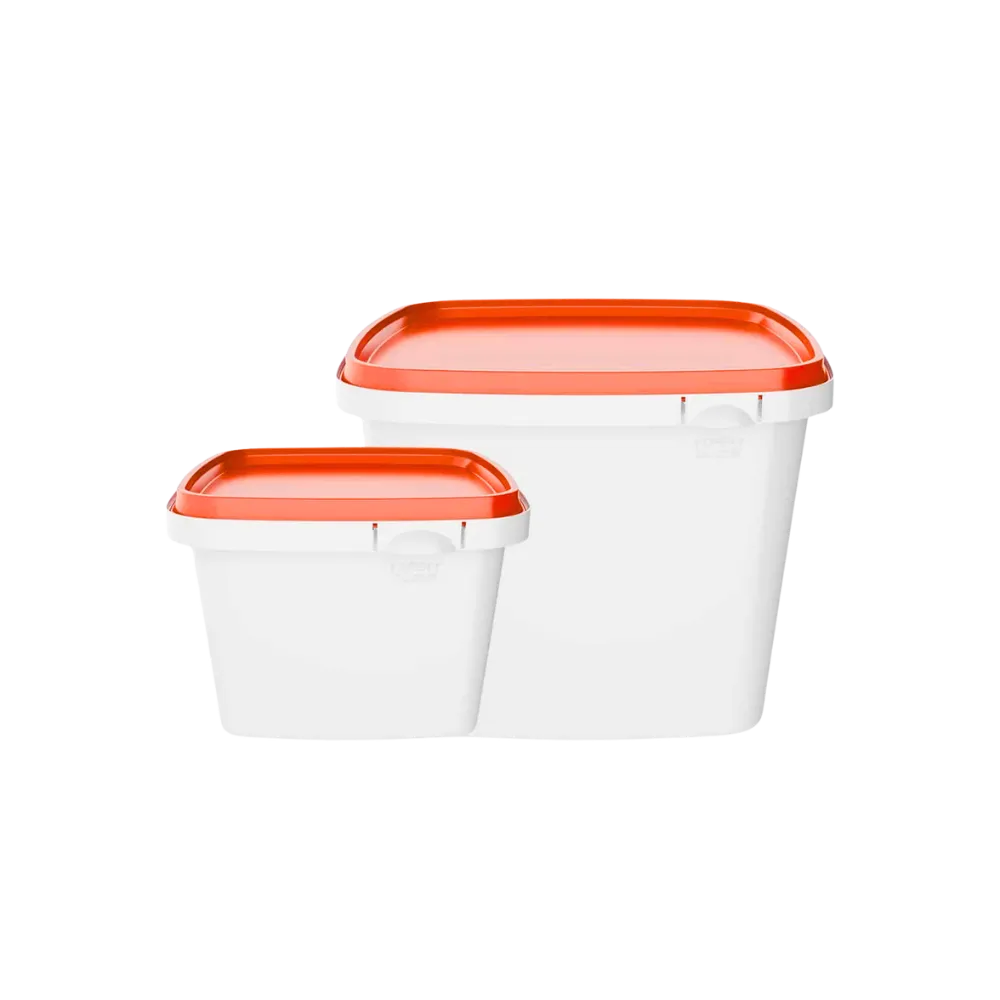
- Shape and footprint. Square and rectangular containers use shelf and refrigerator space efficiently; round containers suit many fill-and-seal lines.
- Decoration surface. Bilingual labels need room. A larger wall or a lid that accepts a label gives your artwork space.
- Retail price point and portion. Single-serve, family and food service portions usually map to different size classes.
- Case and pallet fit. Ask your supplier how each format is packed so you can plan storage and freight.
| Use | Size range to test | Formats to look at |
|---|---|---|
| Single-serve dairy, dips, sides | 8 to 12 oz (250 to 375 ml) | Round Tamper-Evident, Round Film Seal, Square Tamper-Evident |
| Family-size dairy, salads, spreads | 16 to 32 oz (500 ml to 1 L) | Round Tamper-Evident, Square Tamper-Evident, Round Film Seal |
| Ready meals and meal prep | 16 to 38 oz (500 ml to 1.12 L) | Rectangle |
| Deli counter and soups | 8 to 32 oz (250 ml to 1 L) | Heavy-Duty Deli |
| Bulk sauces and food service | 2.6 to 5.5 L | Tamper-Evident Buckets |
For every format with its exact conversion, item number and lid, see our food container size chart.
Choosing a size with Plastiques Horizon
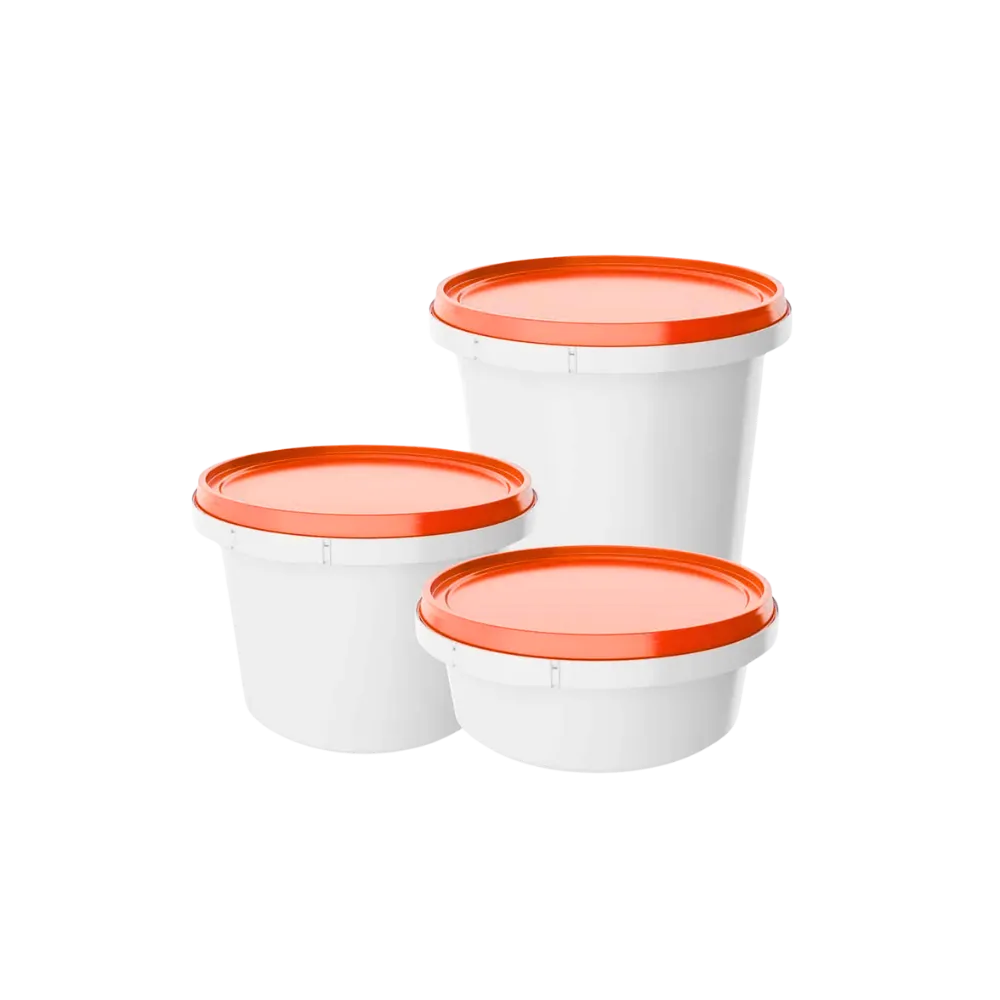
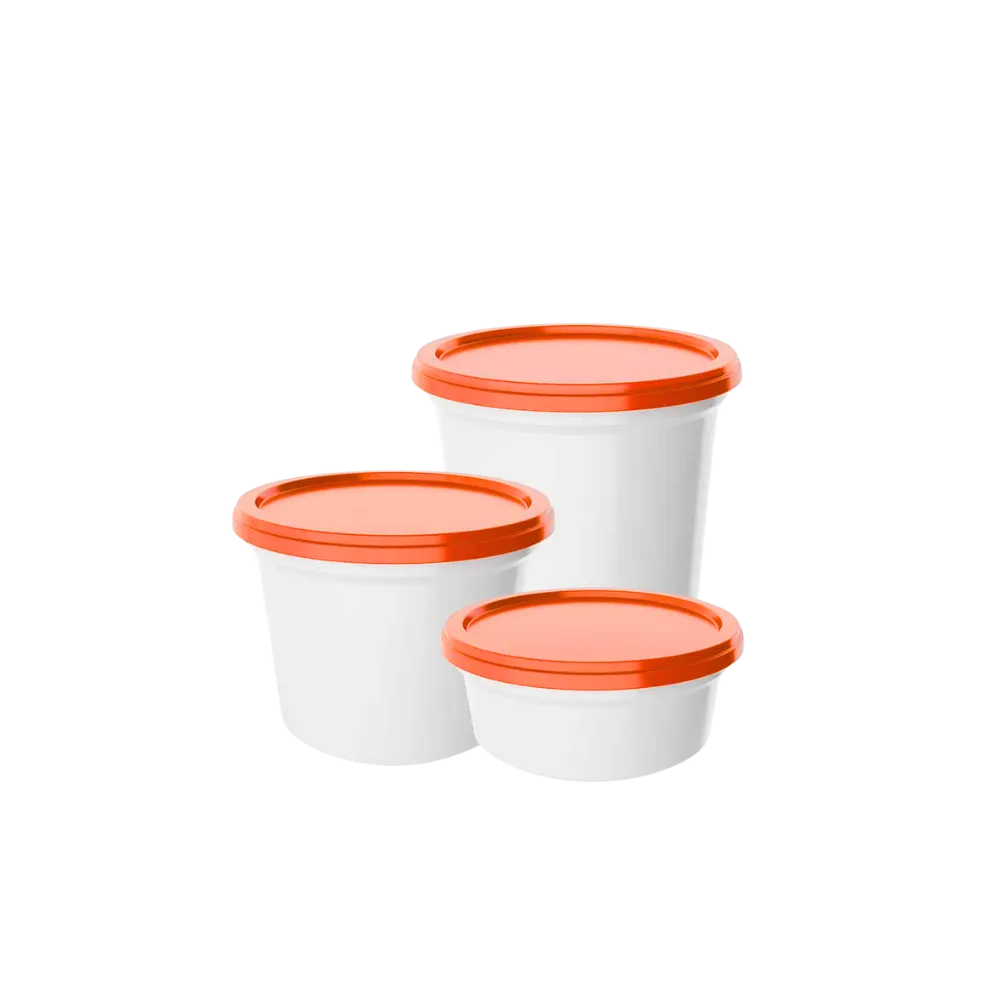
Plastiques Horizon makes six polypropylene lines in sizes from 8 oz (250 ml) to 5.5 L buckets. Several lines simplify the choice: the Round Film Seal line uses one 409 lid for all five sizes, the Square Tamper-Evident line covers six sizes with two lids, and the Rectangle line uses one snap-fit lid for all formats.
Plastiques Horizon sends samples on request so you can run your test fill before ordering. Tell us your product, target net quantity and current container, and we will suggest formats to test. Browse the full product range, request samples or a quote, or call 1-877-630-4095. Our RFQ checklist lists what to send.
Frequently asked questions
Should I choose a bigger container so the product looks generous?
Not if it leaves the container visibly under-filled. The CFIA states that under-filling a container is not acceptable when it would mislead about quantity. Choose the smallest format that holds your net quantity plus the headspace your process needs, and explain any functional extra space on the label.
How do I convert a net weight in grams to a container volume?
Divide the weight by the product’s density at filling temperature. A product denser than water takes less volume than its weight in grams suggests, while an aerated or chunky product takes more. Since recipes vary, the reliable method is to fill a measured sample of your own product and record the volume.
Can I use the same container for refrigerated and frozen versions of a product?
Often, but test both. Frozen products with high water content can expand, which reduces headspace, and not every container is rated for freezing. Check the supplier’s stated use conditions for each line; for example, the Plastiques Horizon Round Tamper-Evident and Rectangle lines are stated freezer safe.
How many sizes should a product range have?
Most brands need fewer sizes than they think. Start with the portions your customers actually buy, then check whether those sizes can share a lid and a case format. Fewer lids and pack configurations reduce inventory, changeovers and the number of label designs you maintain.
Sources
External references consulted for this article. General information only, not legal or regulatory advice.
- Net quantity on food labels · Canadian Food Inspection Agency
- NIST Handbook 44, Appendix C: General Tables of Units of Measurement · National Institute of Standards and Technology (NIST)