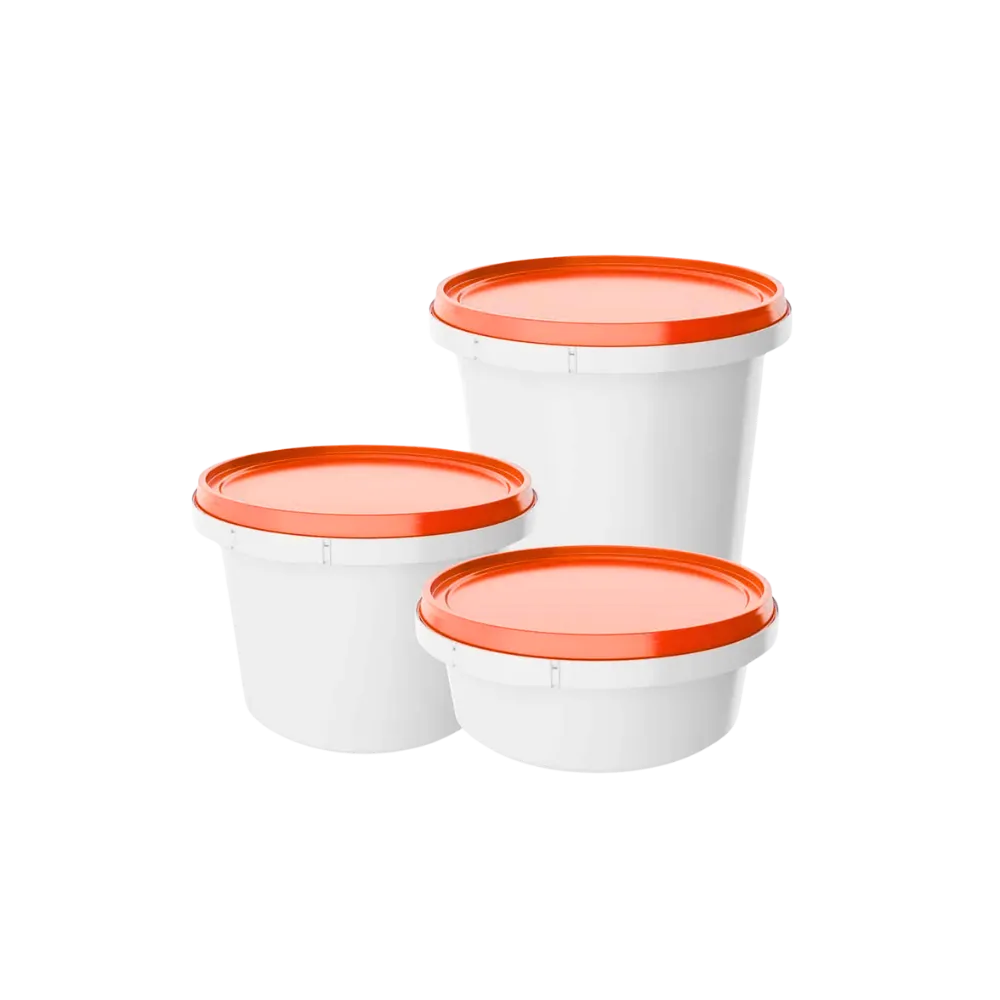
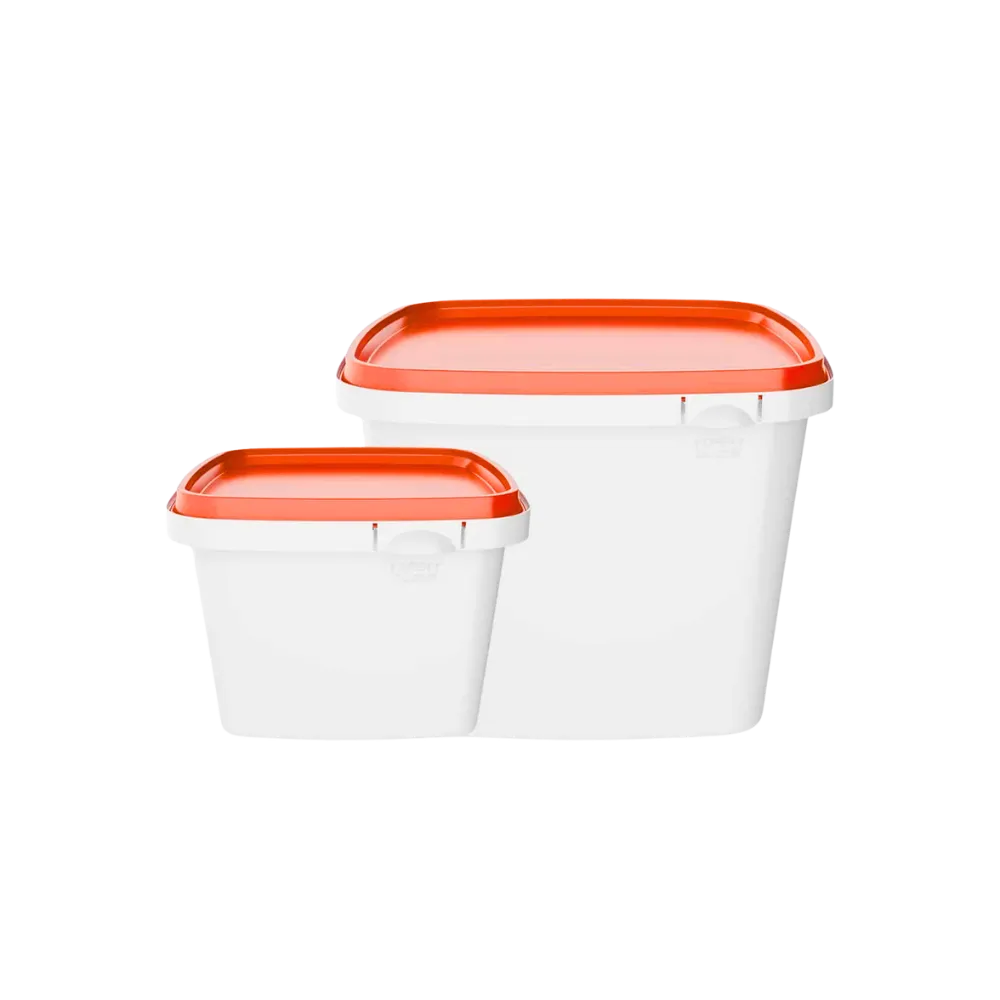
Short answer
Round vs square food containers: round containers have no corners, so they are easy to empty, seal and lid, and a single lid often fits several sizes. Square containers use shelf and case space more efficiently and offer flat panels for labels. A circle fills only about 78.5% of the square it sits in, so square containers make better use of space; round ones are simpler to handle and fill.
Key points
- A round container fills about 78.5% (π/4) of the square footprint it occupies on a shelf, so square containers use space more efficiently.
- Round containers have no corners, which makes them easier to scrape clean, seal and close.
- Square containers offer flat faces for labels; Plastiques Horizon’s Square Tamper-Evident line accepts IML on 1 to 5 sides.
- Plastiques Horizon’s Round Tamper-Evident line uses one lid for all five sizes; the square line uses two lid sizes for six formats.
- Choose by product, line equipment and shelf, then confirm with samples on your own line.
What is the main difference between round and square food containers?
The difference is geometry, and it drives almost everything else. A round container has a circular footprint and a continuous wall with no corners. A square container has four flat sides joined by rounded corners. That single choice changes how the container uses space, how it is decorated, how it is filled and closed, and how the consumer gets the last spoonful out.
Both shapes are common for dairy, spreads, salads, deli and prepared foods. Neither is better in every case; the right one depends on your product, your filling line and where the container will sit on the shelf.
Which shape uses shelf and case space better?
Square containers do. When round containers stand in straight rows, each one occupies a square cell as wide as its diameter, but the circle covers only π/4 of that cell, about 78.5%. That is the square-lattice packing density listed by Wolfram MathWorld. The remaining space, roughly a fifth of the footprint, is air in the case, on the pallet and on the shelf.
A square container of the same width fills nearly all of its cell, minus the small radii at its corners. Staggered (hexagonal) arrangements of round containers do better than straight rows, but shipping cases, trays and retail shelves are usually laid out in straight rows. If refrigerated shelf space or freight is a major cost for you, the square footprint matters.
How do round and square containers compare, point by point?
| Factor | Round container | Square container |
|---|---|---|
| Footprint efficiency | About 78.5% of its square cell in straight rows | Close to 100%, minus corner radii |
| Emptying and scooping | No corners; easy to scrape clean | Product can collect in corners |
| Decoration | Continuous 360° wrap-around surface | Flat panels, readable face-on; more front-facing area |
| Lids | One diameter can serve several heights | Lid matches the side length; larger ranges may need more than one lid |
| Film sealing | Common on round rims and standard diameters such as 409 | Possible, depends on tooling and equipment |
| Corners | None | Need generous radii to reduce molding stress |
| Shelf display | Familiar, traditional look | Neat rows, strong front face |
What are the pros and cons of round containers?
Round food containers
Pros
- No corners, so viscous products like spreads and dips are easy to scoop and scrape out
- A continuous rim that seals and lids evenly all the way around
- One lid diameter can fit a family of sizes, which simplifies lid inventory
- A seamless 360° surface for full wrap-around in-mold labels
- Widely compatible with existing round fill-and-seal equipment
Cons
- Uses only about 78.5% of its footprint in straight rows, so cases, pallets and shelves hold fewer units
- A curved face shows only part of the label to a shopper at one time
- Less distinctive on a shelf full of round tubs
What are the pros and cons of square containers?
Square food containers
Pros
- Uses shelf, case, pallet and refrigerator space more efficiently
- Flat faces present the label straight to the shopper
- More decoration surfaces: front, sides and lid can each carry a label
- Stacks and lines up neatly in display and storage
Cons
- Product can collect in corners, which makes the last portion harder to scoop
- Corners need generous radii; Protolabs’ design guidance notes that sharp corners generate stress during molding
- A wide size range may need more than one lid size
- May need different change parts on a line built for round containers
How do you choose between round and square?
- Product texture: thick, sticky products that are scooped (spreads, cream cheese, hummus) favour round; free-flowing or portioned products work in either.
- Line equipment: if your filler or sealer is set up for round containers or a standard diameter, staying round avoids change parts.
- Space cost: if cooler space, freight or shelf facings are expensive, square saves room.
- Branding: for a full 360° image, round; for a strong flat front face and labels on several sides, square.
- Size range: count how many lid sizes each option needs across your formats.
Then test both with your product. Fill samples, run them through your line, stack them in a case and look at them on a shelf. For capacities, see the container size chart, and for closure choices, read what tamper-evident containers are.
What round and square formats does Plastiques Horizon make?
Plastiques Horizon molds both shapes in polypropylene (PP) at its plant in Saint-Lazare-de-Bellechasse, Québec, each with a tamper-evident rim that shows at a glance whether a container has been opened.
| Round Tamper-Evident | Square Tamper-Evident | |
|---|---|---|
| Formats | 8, 12, 16, 24 and 32 oz (250 ml to 1 L) | 8, 12, 16, 32, 40 and 48 oz (250 ml to 1.5 L) |
| Lids | One tamper-evident, IML-ready lid for all five sizes | Two lids: 4″ for 8 to 16 oz, 5.5″ for 32 to 48 oz |
| Decoration | Full wrap-around IML on the body, IML on the lid | IML on 1 to 5 sides, IML-enabled lids |
| Stated use | Dishwasher, microwave and freezer safe | Ask us about your use conditions |
| Supply | Blank from stock or IML-decorated | Blank from stock or IML-decorated |
See the Round Tamper-Evident and Square Tamper-Evident product pages for details, or the in-mold labeling page for decoration. Plastiques Horizon sends samples of both shapes on request so you can test them on your own line. Request samples or call 1-877-630-4095.
Frequently asked questions
Are square containers stronger than round containers?
Not necessarily. A round wall has no corners, so loads spread evenly around it, while a square container relies on well-radiused corners and its wall design for stiffness. Strength depends on the specific design, wall and material, so compare actual samples under your own stacking and handling conditions.
Do square containers hold more than round containers of the same width?
At the same width and height, a square container holds more, because a square has more area than the circle that fits inside it. In practice, compare containers by their stated capacity in oz or ml rather than by outside dimensions, and test-fill with your product.
Which shape is better for in-mold labeling (IML)?
Both work well with IML. A round container suits a continuous wrap-around label, while a square container offers flat panels that can be decorated separately. Plastiques Horizon decorates its round tamper-evident line with full-wrap IML and its square line on 1 to 5 sides.
Can I switch from round to square containers without changing my filling line?
Sometimes, but plan for it. Fillers, cappers, sealers and conveyor guides are often set up for one footprint and rim. Check with your equipment supplier which change parts are needed, and run a line trial with samples before you commit to the new shape.
Sources
External references consulted for this article. General information only, not legal or regulatory advice.
- Circle packing · Wolfram MathWorld
- How to design corners on injection-molded parts · Protolabs